Thursday, 6 October 2011

Walk 13 - Cattle and Casualties of Time: Painswick Slad Farm

Early autumn now, with the sort of weather you would think normal for October, if last weekend hadn't been more like high summer with temperatures in the late 20's.  But today we're down to the middle teens, blowing a gale and alternating sharp showers and sunny intervals.  Sunshine has been in short supply this week, so now it's appeared I'm grabbing the opportunity to do this walk - a shortish one, like the sunny interval - through a field belonging to Painswick Slad Farm.

I'm not sure we're mentally prepared for autumn, what with an Indian summer happening at the end of September, but the valley is definitely beginning to look autumnal.  Hints of orange and gold are beginning to appear in the trees and there are already drifts of leaves lying on the ground.  The main road runs along the boundary of the field I'm about to walk through and whenever I walk up to the village I tend to stop by this wall because the view from here across the valley is another of my favourites.   It's an unusually open view straight up the valley, and both arms of the upper valley are visible as well as Slad village, the hamlet of Elcombe, Swifts Hill, the Vatch and indeed quite a lot of the ground I've already walked on this project.  It's one of the best spots from which to get a feel for how the valley works.

View from above the field
Normally this isn't a particularly peaceful spot because the main road is humming with traffic, but just now the road is closed for the repair of a major chunk of the retaining wall above the Vatch and the village is almost traffic-free.  This is a pain in the neck for day to day life, but has compensations for lovers of scenery and wildlife.  I've already seen - and heard - two buzzards moseying around above the trees which line the stream.   I seem to be seeing a lot of buzzards in the valley at the moment, so perhaps they bred well this year.

The stream is now running parallel with the road and forms the lower boundary of the field.  This is working farmland, so this field is mainly pasture and is currently home to five or six half-grown cattle.  Earlier in the year I spent a happy afternoon taking photos of young calves with the owner of the field, but these are not the same beasts, apparently.  I'm not even sure if these are the same as the ones I was hobnobbing with at the end of my last walk, which I reckoned were heifers.  Some of these definitely look like bullocks, if not young bulls, with little horns, so I'm hoping they won't find me too interesting.

Entering the field via a gate from the road, I walk diagonally across the steep slope towards the boundary with the church field and the point where I left off last time.  There's a beautiful walnut tree in the middle which is something of a landmark.  The tributary trickle which drops down from the bend in the road and winds to and fro across the boundary is much more visible from this side of the fence.  Sometimes it's a trickle and sometimes more of a steady seep.  At the point where it joins the main stream there is a row of big alder trees whose trailing roots have formed a one big debris-collecting raft across the stream so that the water finds its way around with difficulty.  

The bullocks who have been grazing by the stream are giving me very dubious looks so I walk slowly and talk to them in what I trust is a reassuring way.  Presently curiosity overcomes fear and they come over to have a better look at me, going 'mrrurr-mrrurr' and producing hearty smoker's coughs while shuffling their feet like bashful teenagers. Producing the camera causes them to sheer off temporarily but when I stay put, they sidle back and set about providing me with half an hour's distraction.  I like drawing animals on the move - more exciting, though hugely more difficult, than when they're sitting still - and the bullocks make delightful subjects, barging each other, play-fighting and generally larking about.  Eventually they get bored and wander off, by which time I have pages full of very scribbly and deeply disappointing drawings, but also a very vivid recollection of their shapes and antics.  This is the value of drawing for me - a way of constructing vivid mental impressions which can later be converted into something glassy.

I turn my attention back to the stream and start to walk along it, ducking in and out of single-strand wire fences.  The stream is fenced on both sides very close to its edges as if the water were a real no-go area.  It's quite broad here and the water is beautifully clear.  Despite the usual chaos of fallen wood  around it, it runs fairly unobstructed, except where narrowed by alder roots.  

Broken willow
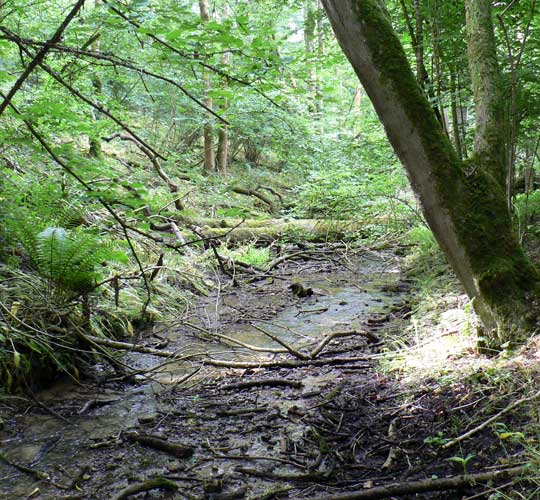
The defining feature along this stretch is the trees - mainly alder and willow, some of them very well-grown.  As elsewhere, it's like walking behind tree-curtains with only the occasional window through the leaves onto the sunlit fields beyond.  It's easy to over-use the word 'secret' in relation to this stream - I seem to do it every time I talk to the sound recorder - but in most areas it really does feel cut off from the world around it.  Here, with tree-free pasture on both sides, the distinction is even sharper.  This stretch of stream seems not so much secret as forgotten, with many of its trees falling into gentle decay.  Here is the massive stump of a very old willow, snapped off about 8 feet up.  Fence supporters have been screwed into its sides, ivy has heavily colonised its deeply-crevassed bark and rusty-winged flies are sheltering in its crevices.  Yet the tree is sprouting green again from the broken-off top.   (I'm always impressed by how tenacious life is in plants.  Except the ones I particularly want to grow in my garden, obviously.)  It isn't the only casualty of time here; there is a whole series of fallen-over, half-broken, ivy-covered, cragged and gnarled tree wrecks.  Their shapes loom weirdly in the green gloom and the sound recorder picks up gothic groanings where one ancient tree continuously rubs against the one next door.

My overwhelming impression of this stretch of stream is of a slice of raw nature sandwiched between two human-controlled areas - like a stratum of striped quartz running through an area of smooth rock.

It's dawning on me that I'm not properly dressed for this walk.  My mind was still in Indian summer mode when I set off, but not only are my light summer trousers not proof against the drifts of nettles, they aren't keeping me warm now that the sun has gone in and I can feel my camera-fingers stiffening with cold.  I step out of the light-and-shade world of the stream into the world of light and sunshine in hopes of warming up.  There is a good view from here of what I think of as the underside of the village - the back end of the pub and the gardens of the houses on the old lane.  

The shadows of the trees are long now, at 4 o'clock, reminding me that it's getting late in the year.  At the far end of the field there is a row of 7 or 8 massive alders, some of them double trees, along the stream edge.  For some reason the pasture marches right down to the stream here and there is very little undergrowth between the trees so that the low sun can shine between them onto the water.  I take this rare opportunity to photograph the stream itself in sunlight - along much of its length, in the shade of the trees, it looks too amorphous for interesting photos.  I also try to capture the magnificence of this row of alders and run up against my lack of photographic expertise and the problem that if you can get the whole tree into the shot, you're so far away that it tends to come out looking small.

On the field boundary, something unexpected happens.  The stream suddenly plunges over a waterfall and literally disappears, perhaps into a culvert of some sort, in the garden of (I think) Upper Vatch Mill.  So that's the end of my section of stream for today and time to walk home along the road, admiring the effect of the golden late-afternoon light on the stone buildings at this end of the valley.

Google map of this walk

Friday, 2 September 2011

Walk 12 - A short walk though long grass: the Church Field


View from the church field gate

Almost a month since I last managed to fit in one of these walks, due to general busy-ness, so I'm feeling seriously deprived and looking forward to this one.  This is the first walk I've been able to do without getting in the car first, since the entrance to the field is ten minutes up the road from us.  The church field (so called because - ta-da! - it belongs to Holy Trinity church, Slad) is a curiously L-shaped field running steeply down the hill below the church and wrapping itself around the gardens of the houses on the Old Slad road.  It adjoins the Steanbridge estate on one boundary, and farmland on all the others, except for a gate at the apex of the triangle which goes out onto the main road.  It's this gate I'm now heading for.

The thing about the church field is that it isn't grazed or managed, except that the grass gets cut annually, which hasn't happened yet this year.  It's used occasionally for village events, such as the newly-traditional Easter Egg and Bonio Hunt (children and dogs welcome), but its steepness saves it from fetes worse than death or other more genteel activities.  Last time I saw it, which was from the Steanbridge estate boundary, it was elbow-high in nettles and other vegetation, so although it's warm and dry today, I'm wearing wellies, jeans and a thickish canvas top, and feel somewhat overdressed.

Wild carrot seed heads
Which is OK, because the field is somewhat overgrown.  Even on the rough path which runs down from the gate, the grass, nettles and hogweed are knee-high.  As I climb over the gate, I'm greeted by a dunnock from a nearby bush, and a couple of bluetits, and a shower of small green grasshoppers bounce away from my feet.  The days have been hot recently, but at this hour of the early-ish morning it's cooler than of late, and slightly misty, with intimations of autumn.  I think this may be the last walk of summer.  The field already looks pretty autumnal - there are blackberries appearing along the boundary hedge and though there are a few wildflowers still blooming, particularly the knapweeds, the grass is browning at the edges and is full of seedheads.  I love seedheads - their shapes are intricate and more subtly interesting than the flowers that precede them.  I particularly like one which belongs to a plant which is common along this path and which I ignorantly accuse of being cow parsley.  Its seeds are clustered together in what looks like a particularly intriguing birds-nest.  Later research (this time I did look it up in the spotter's guide when I got home) reveals it to be wild carrot, a much prettier member of the same family.

The view from the top of this field across the valley towards Swift's Hill and the hamlet of Elcombe is one of my favourites in the valley, particularly on an atmospheric morning like this one, when the opposite hills turn blue and seem to float on the mist.  Most of the view is fields, with a dark line of trees below me marking the path of the stream.  A great squawking of magpies from one of these trees heralds the eruption from the tree canopy of a big buzzard, calling mournfully.  The field boundary away to my right is a fold in the land running down from the big hairpin in the road and hosting a small stream, audible but not visible from the road, which I mean to try to find today.  From up here, the church field looks like a large, shaggy and somewhat unkempt animal with flowers caught in its fur.

My progress down the hill is slowed by the detail that's all around me.  I remember thinking about a section of ground near Dillay Farm that it would be fascinating to choose a square foot of it and work out how many different plants were in it, and this is another place with that kind of density of species.  There is so much more here than just grass.  Here, for example, is a clump of many different seedheads, even less identifiable than usual (to me) without their flowers, but fascinating.  The whole clump is glazed with what I think must be slug-slime or similar, which sounds revolting, but shining in the sun is actually ethereally beautiful.  And here is a patch of pinky flowers which once again I feel ought to be something-or-other-vetch, amongst which are many small spiders going about their business.  That makes it feel like autumn - I associate autumn with spiders being much more in evidence, for some reason.  The pink flowers are shaped like medieval wimples and I stop to try and draw them.  It's one thing to admire a shape, quite another to commit it to memory, and a whole quantum step away again to transmit it from brain to hand and pencil accurately.  Why this should be, I don't know, but I think we see things in different ways.  There's one sort of seeing which registers an opinion, and a different sort of seeing - a much more intense seeing - which allows you to draw what you see.  For example, someone once pointed out to me that you can look at your watch and not remember what the time was afterwards, because you looked at your watch to answer the question 'have I got time?' rather than 'what is the time?' - apparently, answering the two different questions involves two different ways of seeing.

The path - which is more like a sort of green ramp - follows the curve of the field round underneath the gardens of the houses above and peters out close to a clump of trees which bulges out from the northern boundary.  Now I've been told that somewhere in these trees are the remains of an old silk mill from the days when this valley was part of the great British textile industry.  Silk mill?  I doubt that silkworms were cultivated in Gloucestershire, so I guess the silk was imported in its raw state for finishing here.  I can't imagine the economics of that but presumably there were some.

At first I think there's no chance of spotting anything man-made for the grass and nettles and general plant mayhem under the trees, but then I come upon a section of old stone wall, which has become part of the hill.  Ferns and ivy and whole trees are growing out of it.  And a little further along is a spring trickling out of a brick surround.  The ferns and plants clustering round it makes it look like a pagan shrine, not at all like anything industrial, but I'm guessing this may have been part of the silk mill building.  I'm struck by the light effects down here - green gloom punctuated by sudden shafts of sunlight which highlight the shapes and colours of the ferns, making them look hyper-real.

Exploring the bank in more detail I find no more signs of man-made things but some beautiful big trees and a barbed-wire fence, on the other side of which the old watercourse I walked up on my Steanbridge estate walk is clearly visible.  Turning downhill along the fence I seek out the stream, following an animal path that eventually disappears with a flurry of scrabbled-up earth under the fence which closes off the stream in both directions. Following the example of the unknown animal, I manage to roll under the fence in order to get close enough to the stream to record its placid burbling.  I'm inside the usual stream-shroud of hazels and willows but I can't follow the stream bank here because of the fence, and because the tree cloak is augmented by thorn bushes, so  I have to return to the grassland, outside the trees, avoiding nettles which, in some cases, are over my head.  The nettles are popular with tiny snails, if not with me.

I come upon a real autumn sight; a hawthorn bush covered in brilliant red berries.  Or fruits.  Whatever.  Are these haws?  I know the phrase 'hips and haws', but now I come to think about it, I've neve known what 'haws' are.  'Haws' for hawthorn?  It seems logical.  There are also sloes.  At least, I think they are sloes.  (Never drink sloe gin made by me, just in case.)  The animal path I'm following winds back to the stream and spends the next few minutes playing cat's cradle with the barbed wire fence, which snakes all over the place crazily.  Presently I find myself on what appears to be a small island, the stream on one side and a shallow but definite ditch, with a small amount of water in it, on the other.  Crossing the ditch higher up is what at first glance seems to be another little arched stone bridge like the ones I've seen higher up the stream, but almost buried in the earth and accumulated leaf litter and with a tree growing on its head.  Looking closer, and feeling the cold draught coming out of it, I think it's actually a culvert of some sort.  I try to work out where it's coming from, but it's impossible to see because of the undergrowth.  I'm wondering, however, if it's something to do with the water system that drove the old mill.

This stream-and-ditch arrangement continues almost to the edge of the field and the main stream is really quite small here - it's amazing how much it varies in size along its length.  Just beyond where the two finally meet, I can now see where the tributary trickle, the one which comes down from the hill by the bend in the road, joins the main stream.   This little tributary winds in and out of this field and the next, where a huddle of young heifers are watching me.  When I amble over to say hello to them, they stick their noses through the fence for a closer look, whiffling curiously.  I can't resist their liquid eyes and neat, blunt noses so I stay to make a few scribbly drawings of them, probably providing the most excitement their day will offer.

My aim is to walk the final boundary of the field by following the tributary back up to the road, but this is easier said than done as it's well hidden in a melange of blackberries, brambles, nettles, hawthorns and general plant mess and I keep having to depart from it to avoid being ripped to shreds.  In the end, I give up and strike back across the hill towards the gate, wading effortfully through long, tussocky grass punctuated by scabious and cow parsley (aka wild carrot), arriving back at the gate hot and out of breath and feeling like I've covered a much greater distance than I have.


Google map of this walk


Wednesday, 27 July 2011

Walk 11 - A Flash of Blue: Steanbridge House lake and woods

Steanbridge House and stream
It's now high summer, or at least as high as it's likely to get this summer, which has been pretty patchy to say the least.  Today's reasonably summery, though, with blue skies, high clouds, sunshine and quite warm.  I've had a break from my walking project for the last two or three weeks, due to exhibitions and other distractions, and I'm glad to get back to it.  I'm starting from the village pond and the plan is to walk follow the stream through the land belonging to the Steanbridge estate.

Steanbridge House is the Big House of the village, and for generations the home of the Townsends, who owned most of this part of the valley including Steanbridge Mill.  The current estate is smaller, but includes a big chunk of the Slad brook ,which the present owners have kindly allowed me to explore.

A genuinely good place for kingfishers
The pond is busy with ducks today and they oblige me with a volley of quacks for the sound recorder - presumably saying "Give us yer bread then" in duckish - before I climb over a gate on the opposite side of the little bridge and set off into Steanbridge estate land with the stream on my right.  I've not taken more than a few steps when a flash of electric blue darts out in front of me and disappears downstream.  A kingfisher.  What a brilliant (literally) start to the walk.  It's really good to see it, because last winter was very cold and kingfishers are one of the species known to suffer in a bad winter. And not so far away from the bit of stream I imagined as a good place for kingfishers.  Though probaby this bit is even better, being deeper and less shaded by trees.

I'm walking through a field, the grass still shining with water droplets.  This part of the stream has a thinner clothing of trees than elsewhere, and the trees seem to be bigger and more varied than the usual hazel/alder combination.  Here's a sycamore, a stately willow, and a beech.  The stream itself looks as though it has aspirations to grow up into a real river one day, being wider and slower-flowing.  It has the air of somewhere that significant fish (i.e. ones you can see without a magnifying glass) might live, which presumably it is if kingfishers hunt along here.  I suspect the difference is the result of active management in place of the benign neglect that seems to operate along most of the stream up to this point.

The kingfisher is rapidly followed by fourteen teenage mallards, doing what teenagers do, viz: going around in a big gaggle, flapping their wings and making a fair amount of unnecessary noise.  I wonder if some of them are the group I saw a few weeks ago on the pond.  I follow them down to the point where the stream opens out and becomes a long, narrow lake, reflecting mown lawns and the handsome profile of Steanbridge House.


This is a very different environment from those I've been walking in up to now. There are only occasional trees along the bank and those that remain are well-grown, ornamental-looking specimens. Instead, the banks wear intricate sharp-edged patterns of tall grasses, reeds, bullrushes and iris, punctuated by brilliant pink spears of purple loosestrife and fluff-explosions of meadowsweet.  The water is deep and very clear and full of a curly weed that I've seen nowhere else on the stream.  I can't see any fish, but I don't doubt that there are some.  The centre of the lake sprouts an ornamental duckhouse and a lot more ducks than would fit into it, some mallards, some more exotic.  As I watch, a lone swan sails stiffly downstream, driving a swathe of ducks before him, including four baby coots (cootlets?) and a moorhen.

In the centre of the opposite bank a massive oak tree spreads its arms wide over the scene.  It's a truly magnificent tree, so large that I have to retreat some distance to get its whole width into the camera frame.  It must be one of the biggest, if not the biggest, tree I have seen along the stream so far.  It makes me realise that I've seen very few such huge trees anywhere in the valley.  I wonder if it was planted when the house was originally built.

A little further on is a similarly venerable and beautiful willow.  A scatter of Large White butterflies are enjoying the purple loosestrife.  As I follow the eastern bank, I'm startled by the sharp squawk of a moorhen, apparently under my feet, so she must be hiding in the reeds right beside the bank.  Overhead, a couple of buzzards are circling and mewing.  The scene is a curious mixture of wild-ish and garden-ish, and it does make a very interesting change from my walking so far.  The sound recorder isn't getting much action, though - apart from the occasional moorhen shout, there's not much noise on this wide, smooth, unobstructed water.

At the far end of the lake, the stream flows out under a little bridge and drops down several feet into a stone-walled channel via a man-made waterfall, so there's meat for the sound recorder in that, and also further on where the stream loses more height in a series of small cascades.  At the end of its tumble the stream is once more its normal self - shallower, fast-flowing, surrounded by trees and busy with debris, like someone reverting to comfortable scruff attire after a poshed-up night out.  And the garden has morphed seamlessly back into woodland and scrub.  Hazels, alders and willows are once more the order of the day, but with an added leaven of sweet chestnuts, which is less usual.  The scrub is attracting butterflies - a pair of red admirals skitter past me, and others which won't sit still long enough to be identified - pale brown and vaguely brindled.  And here, in the middle of this wildish woodland, is an elegant little iron bridge.  It's a bridge to nowhere, since once you've crossed it you're hard up against the barbed-wire boundary fence with the field next door and there's nowhere to go except rather precariously along the opposite bank.  I can't work out why it's here, and feel there must be a story involved.

I'm now following a track through the woodland.  I'm back in the world of the secret stream; even with the iron bridge as a reminder, the world of the lake and the house already seems miles away.   It's that part of the year when the trees are summer-heavy with so much leaf that any view of the outside world is blocked as if by green velvet curtains.  A large brown bird flaps out of the leaf-curtain above me and crashes away into the canopy, only identifiable as a buzzard by its characteristic mew.  I can also hear green woodpecker laughter somewhere in the vicinity, but not, of course when I've got the recorder turned on.  Think maybe I should start a list of The Sounds That Got Away, which would include the earlier moorhen squawk.

On a deep meander in the stream stands another massive tree, all dolled up in ancient ivy.  It's so surrounded by smaller hazels that it's hard to make out what its own leaves are but I'm sure it's an oak.  I wonder, from its size, whether it was planted at the same time as the one by the lake, and whether there were once more of them.   An avenue of oaks?  The ivy growing on it is so ancient that its bark is as ribbed and textured as the bark of the tree itself.  It is currently home to a multitude of spiders who have spun their webs between its stems.

The woodland floor is carpeted with hazelnut shells here.  Having recently been on a course with Gloucestershire Wildlife Trust on identifying signs of small mammals (starting to take all this a bit seriously, you see) , I am looking out for any that show signs of being nibbled by voles or mice.  Unfortunately, all the ones I can see have clearly been scrunched by squirrels.  It's like searching a clover patch for the one with four leaves.  But then I find a small mammal-sized hole in the ground, and satisfactorily close to it, a nut with a small circular hole chewed in the top of it.  Not squirrel.  Are there tooth marks round the edge of the hole?  Hard to tell, in this light, but there are no tooth marks on the rest of the nut (I think) so that means it could be a vole (bank or field) or a dormouse.  Probably a vole - judging by the number we saw on this excellent course (good fun - try it yourself!), voles are in the majority.  It's pretty exciting to think I might be sitting on a vole's doorstep.  Doing the equivalent of rootling through its dustbin.  Hmm.

Large white on purple loosestrife
The stream now disappears briefly into a pipe.  The track I've been following crosses it and heads for a gate in the field beyond, but the stream is still on this side of the field boundary, so I stick with it, despite the fact that this looks likely to involve wading through shoulder-high nettles.  Forging into the undergrowth, I disturb a wren, which darts away in front of me, calling names loudly.    Now my attention is attracted by an unexpectedly steep bank on my right, which looks for all the world as though someone - several someones -  have been sliding down it repeatedly on their bottoms.  Reasonably substantial bottoms - I have a mental image of roistering badger cubs...  On the far side is what looks like an old watercourse, perhaps a mill leat, which would explain the bank.  Following it, I find that it curves around and joins up with the stream.  I'm guessing it's probably part of an old mill system.  Only a little further on, barbed wire fences march right down to the stream on both sides and I need to cross one or other of them in order to find out where I am because I suspect that the fences mean I've now reached the end of the Steanbridge estate land.  It's surprising how difficult it is to pinpoint your position in country like this, even with a detailed map.  Some scrambling gets me over the right hand fence and into an area thigh-deep in nettles and brambles, all overlaid with a mattress of goose-grass.  A little more wading through this plant chaos gets me into a position to see ahead, and confirms my suspicion that this is indeed the church field, which is the next bit beyond beyond the Steanbridge land.  I've hit the furthest end of today's walk.  Time to retrace my steps.

I decide to try walking back up the old watercourse to see where it goes.  I think I've found it on the map, where it's shown as a straight, blue line coming away from the Steanbridge lake and parallel with the main stream.  So it is supposed to have water in it, as far as Ordnance Survey are concerned.  The plants growing in the bottom of it suggest this hasn't been true very recently, but its appearance on the map adds credence to the idea that it was part of a man-made water system.  It runs higher up the hill than the main stream and skirts the edge of an area of beech woodland.  Partway along it, dug into the steep and sandy bank in the roots of the beech trees above, is a series of holes, increasing in size and a substantial accumulation of poo.  Not twisty-tailed poo but well, basically just squidgy.  (Too much information?  Blame Chris Packham.)  Cudgelling my brains to remember what we were told on the mammal course, I wonder if this could be a badger latrine.  Which adds fuel to my wistful speculations about badger cubs and the bank...

Walking in the watercourse is tricky because it's deep in branch debris and leaf litter.  After stumbling along it for some distance, I emerge into sunshine and a major nettle patch behind the summer house at the end of the lake.  Which proves that I've been walking along the blue line shown on the map, although from this vantage point it seems to me that the lake and its surroundings are not quite as they are shown on the OS map.  The whole position of the lake relative to the stream seems to have changed.

Anyway, I'm now on the homeward path, back up the lake, past the swan, past a moorhen and her two small chicks, diving just in front of me, past the house and back to the gate by the village pond.  Here, just before I turn the sound recorder off, a buzzard flaps heavily away just ahead of me and gives me something I've been hoping for - a really good, closeup recording of his cry, which to me is one of the defining sounds of the Slad Valley.

Google map of this walk

Tuesday, 5 July 2011

Walk 10 - Of hazels, holes and giant squirrels: Upper Steanbridge Mill garden

I'm on my way back down Steanbridge Lane, having now got permission to go and look at the bit of stream which, after leaving Down Farm land, runs through the garden of Upper Steanbridge Mill and then under the lane to join up with the Dillay running through the Fairgrieves' garden in the other half of the mill.  And if that sounds confusing, it's because the garden of Upper Steanbridge Mill is actually on the other side of the road from the house itself, and is a narrow triangular tongue of land along the stream, projecting into the Down Farm fields.  This is going to be another short walk in distance (less than 100 yards, I judge) - but in time?  Who knows?

On my way down the lane I meet friends from the village returning from walking their dog.  They describe having seen a fox and two deer at unusually close quarters.  As I discovered after my recent fox cub experience, there's an element of mild competition about discussing wildlife encounters with local friends, of the 'I'll see your two deer and raise you five fox cubs' variety, which is quite entertaining, as well as instructive, since it makes you realise that for people who are out in the valley regularly, such as dog walkers, there is plenty of wildlife to be seen.

A brilliantly sunny morning, but chilly for this time of year, feeling almost autumnal, which is slightly worrying as it's still only early July.

Bosky path
I enter the garden via a gate from Steanbridge Lane.  The first part is relatively garden-like, with mown grass and a vegetable plot and summerhouse, but also plenty of trees and laurel bushes.  A fallen willow has been creatively propped to form a children's climbing frame and there's a platform in a tree which ought to be brilliant for watching birds.  Then the domesticated part of the garden simply stops, and I'm in woodland, following a slender green path winding through the trees.  The word 'bosky' must have been invented for this particular path. Once again there's that sense of being in a secret place - I can't see the outside world at all.  I tell a lie - I catch the odd glimpse of the racehorses grazing in the fields beyond.  But there's no sense that they might see me.  In fact, I feel I am walking unseen by all eyes except the birds chittering disapprovingly in the trees above me.  These seem to be youngish trees, for the most part, tall and slim, many of them ash.  There are occasional piles of old logs which have been left alone to be covered by moss and ivy and other creeping plants and must be appreciated by the local wildlife.

Pause for a Chris Packham moment as I discover a little mound of poo.  All those of a sensitive disposition, look away now.  This does not look like the usual (i.e. dog's) and some of it has a twisty tail coming off it which (I seem to remember from Springwatch) means it could be fox.  Nearby are signs of shallow digging, so someone, fox or otherwise, was busy here recently.  Why do I get excited about finding signs of the other mammals who share this countryside with me?  As my earlier conversation with my dog-walking friends indicates, there are plenty of them about.  Can't imagine a badger nosing thoughtfully at a dropped crisp packet and saying 'Hmm - looks like human; wonder what they were up to last night?'

The woodland gets narrower and narrower until it comes to a stop up against fences on both sides.  I'm now at the apex of the triangle, and the point where I stopped on my last walk, but on the other side of the fence I saw the stream disappearing under.  The sound recorder and I stand here for a while, listening to the sound of the stream squeezing itself past the debris which has accumulated against the fence.  There's an unusual-looking tree in front of me.  I think it's an ordinary ash tree, but it has lost a long, v-shaped swathe of its bark, like a tear in a piece of paper, up to a height of about 10 feet.  Unfortunate for the tree, but it gives it a most striking appearance, revealing watermark-like patterns in the heartwood, and orange tinges along the torn edges of the bark .  I wonder what might have caused this - if this was Africa, I'd have guessed elephant, but we only have squirrels here. I'd have thought it would take a squirrel an enormously long time to achieve the same effect.  Pause to ponder the possibility of an elephant-sized squirrel lurking somewhere in this woodland.  Return of The Beast of Slad?

I've got stereo stream noise in my ears; in the left ear, the sound of the stream forcing its way noisily past the fence and its accidental dam of debris, and in the right ear the rush of another set of miniature rapids 10 or 12 feet further on where it flows round a bend and drops over a lip of stones.  In fact, this bit of stream is noisy along most of its length; its bed is rocky, and every now and then a jutting rock creates a little rapid, or the roots of a tree induce a tiny waterfall.  (I'm piling up the sound recordings now.)  Where branches have fallen across the water, creating mini-dams, you get a brief pool of smooth water above the dam, then rapids below, in some places a series of them, like a necklace of smooth pearls held together with twisty ropes.  This transition from smooth water to the texture of the rapids fascinates me for some reason I can't quite put my finger on.  I try to draw it, to find out, and utterly fail to capture what I'm seeing, only succeeding in fixing it in my mind as something to remember.

I have an odd sense of freedom because this is such a short stretch of stream to cover and I haven't arranged to go any further today, so I don't have to worry about how long it will take me to walk it and can spend time exploring it in as much detail as I like.  Also, being a fenced-off garden, it's safe to dump my bag of art kit by a tree for the moment and scramble about the banks of the stream looking closer at things.

Multi-stemmed hazel trees lean down protectively over the stream, accentuating the sensation of hiddenness. It looks to me as though their roots are what's mainly keeping the banks together.  As well as roots, the banks are clad in ivy, hart's tongue ferns, brambles and nettles, with a scattering of pink and yellow wildflowers like battenberg cake crumbs.  There must be bluebells here in spring; their trefoil-shaped seedheads are visible in some places.  In a muddy area I find vague signs of some small animal having come down to the water to drink, and in a steeper, undercut section of bank, shaded by curtains of trailing ivy, I spot a significant-looking hole, perhaps three or four inches across.  Is it a lived-in hole, I wonder?  If so, by who?  Vaguely remember that water-vole holes can be identified by neatly munched 'lawns' close by, which rules this one out since there isn't a scrap of grass to munch.  It occurs to me that human dwellings can often be identified in the same way, though not always.  Perhaps this hole belongs to the vole equivalent of someone who prefers paving stones to grass.


Further on are other, smaller holes.  The undercutting of the bank suggests to me that at some point the stream had more water in it than now.  There are slots in the mud by the stream - maybe deer.

Remind myself to look up.  Because the trees are close together here, they have all grown up very tall and slim with few branches at the lower level, but the ashes, in particular, make a beautifully patterned canopy of gold and green, sun and shade.

My attention is caught by a lot of buzzard mewing going on in the field, in much the same area where I heard a lot of bird fussing going on at the end of my last walk, so I'm wondering if it was the buzzard causing the general alarm then.  I've noticed that I often see them in the same places on my regular walks, so I assume they have regular roosts and hunting areas.

With time to spare, I've no excuse for not making a more detailed drawing, except that there's so much visual stimulation here that it's hard to decide what to concentrate on.  In the end, I choose a view up the stream towards the top-of-the-triangle fence, because of the intricate patterns made by hazel stems across the stream.  While I work, I vaguely register movement in one of the trees in front of me, track it to a hole in the trunk.  This hole is definitely occupied; a wood pigeon is nipping in and out of it, so presumably has a nest there.

It's always good to spend time sitting still and drawing - I find it fixes my impressions of a place much more vividly than any amount of looking through a camera lens.  Trouble is, I'm not a quick sketcher, and one can capture so many more impressions with a camera.  Wish I'd been trained to draw fast.  Wish I'd been trained to draw properly...

I follow the stream back into the domesticated garden, past a triptych of majestic willows, tall and graceful, past the spears of irises growing with their feet in the water, to the point where it tumbles over a small waterfall and disappears into the mouth of a pipe and under the road.  A few yards from here, in the Fairgrieves' half of the mill garden, is the point where it joins up with the Dillay.  Before leaving the garden, I look back towards the beginning of the woodland path, disappearing into a haze of green, and it strikes me that it could have been the original for the road to fair elfland, the one that (according to the song) runs at right angles to the road to heaven and the road to hell.  Those who follow it disappear for years and return, still young, to a world grown old without them.  This place has something of that other-worldly spirit about it.   Certainly I seem to have spent a lot longer here than I intended.

Wednesday, 29 June 2011

Walk 9 - Root, branch and green canopy: Down Farm fields

This morning's problem is to find my way back to the point in Detcombe Woods where I finished the previous walk, via a footpath through Trillgate Farm which turns out to be easier to find on the ground than it is on the map.  It runs through the corner of a field full of red and white clover, dusted with a scattering of Meadow Brown butterflies.  Last week we had temperatures in the 30s, but today is slightly chill and altogether better for walking.

Green marquee
I can hear the stream even before I reach it, tumbling over a little waterfall before vanishing behind a curtain of undergrowth.  My aim now is to walk back upstream until I find the big fallen trees which mark the point where I finished the last walk.  As usual, the stream is wrapped in a protective shroud of trees and undergrowth.  An animal path gives me an entry point into a world made even more than usually secret by the steepness of the bank which means that the first branches of the trees growing out of it are on a level with the ground.  It's like being in a big green marquee, formed not only by the usual multi-stemmed hazels but also one or two really large trees, including beeches, which, so far, have been rare beside the stream.  The sun breaking through the clouds at this point carpets the ground with golden dapples. This closed-in area has the appeal of a child's den, and I'm tempted to stay a while, but I really need to get on because I'm not sure how much further up the stream I need to go to get to where I ought to be starting.

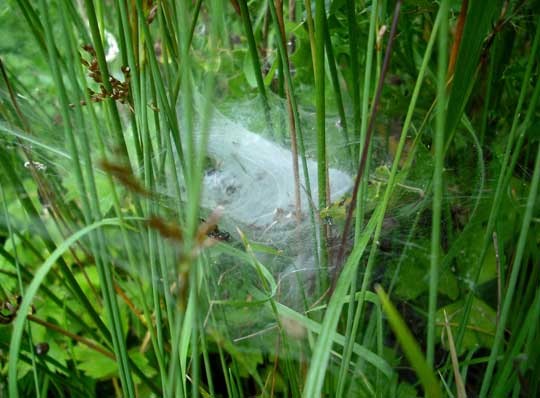
The boundary on the stream between the shooting consortium's land  and the land belonging to Down Farm, which I'll be walking through this morning. is easy to spot from this direction.  It's marked by another little waterfall, caused by the build-up of debris against the wire fence which runs right across the stream.  The stream above the fall is muddy and below the fall is quite clear and sandy as if the impromptu dam is acting as a filter.   This isn't where I left off, though, so I forge on through the trees, startling a deer which had been grazing on the edge of the meadow beyond.  It seems a shame that my first sight of wildlife on these walks is invariably the movement as the animal turns to flee, and I resolve to walk more quietly.  That's not so easy; I have the impression that humans don't take much interest in the stream along here - the banks are steep and littered with twigs and the stream itself is bridged by so many fallen branches so that just walking alongside it is a tricky exercise, never mind walking quietly.  I'm eventually forced out into the meadow beyond.  There are compensations - sunshine on dew-soaked grass picking out many spiders' webs in shining droplets; the occasional spotted orchid; a vociferous marsh tit bouncing about in the low-stooping branches of an ash tree.  I like marsh tits, with their neat black heads and dapper buff waistcoats, and the way they whisk to and fro with verve and confidence, like James Bond birds on a mission.

Spider's webs in the meadow
At the corner of the meadow I recognise the point where I climbed the hill away from the stream last time and after climbing through the fence to rejoin the stream, lapped about by the scent of wild garlic, I find the big fallen trees and know I've rejoined my previous path.

Heading downstream again, I decide to try and stick with the stream this time rather than climbing back up to the meadow.  The green marquee effect continues.  Along the banks, areas of dead leaf-litter with no sign of greenery alternate with areas thick with very-much-alive nettles and other colonising plants.  I guess it must be the amount of light penetration through the canopy that makes the difference.  Many of the trees are clad in a fretwork of ivy.  The stream itself is noisy with many little rivulets and mini-falls caused by the amount of fallen wood which has landed in it.  In spite of which, the water seems very clear.  I spend a little time looking hopefully for anything that might be living in it, but can't spot anything.  A fat bumble-bee drones around me and I wonder what he might be looking for, because so far I haven't seen a single flower down here under the shroud of trees, but perhaps he's just come down to drink.

My progress down the stream is slowed by fences which regularly veer right down to the water and force me to cross and re-cross it.  The fences are presumably to control the access that stock has to the water and walking along this part of the stream is obviously not normally on anyone's agenda.  This a problem I've encountered before with trying to walk through the valley on a route which doesn't correspond with human pathways or ways of thought.  Arriving at a particularly serious fence which coincides with a small, steep-sided tributary coming in from the hillside, I debate whether to cross the stream again or attempt to cross the fence.  Someone else has gone ahead of me; there are scrabble-marks in the soil of the steep bank below the fence and a fairly significant dint in the bottom of the wire where something largish has pushed its way underneath.  Badger, maybe?  No helpful hairs on the fence to tell me.  I consider trying to do the same, but decide that as I haven't got a thick fur coat and claws it might not be such a good idea.  Instead I wade through deepish mud, cross the stream with the aid of a discarded tyre and move on to a point where a semi-collapsed alder tree has helpfully pushed the fence down to a point where I can step over it.

Self-Heal (not vetch!)
There seem to be far fewer birds here than there were in Detcombe Woods - perhaps because it's basically an area of fields and the only trees are the ones along the stream.  It's very quiet, apart from my galumphing, twig-breaking steps, and very still, apart from the small, subtle movemenf of the stream.  After a while the green gloom gets a little oppressive and I take a detour into the adjoining meadow to recover the sun, marvelling afresh at how its corridor of trees effectively isolates the world of the stream from the valley around it.  It's a nice meadow, with buttercups and red clover and something small and purple which I feel should probably have the word 'vetch' attached to it.  (My knowledge of wildflowers, beyond the obvious ones, is incredibly hazy.  Like my mother before me, I go out on walks, spot flowers, wish I'd brought a spotter's guide with me, mean to look them up when I get home, and hardly ever do.)  Lots more spiders' webs amongst the grass, too.

I've now arrived back at the point where the path from Trillgate joins the stream.  Continuing on the eastern side of the stream through Down Farm land, I presently come across an old brick housing half-drowned in nettles and containing what looks to me like a non-operational ram.  The sound recorder and I can hear water trickling down inside the housing but there's no movement in the mechanism.  A brass plate attached to its corroded dome declares it to be a Blake's Hydram.  I wonder how old it is and whether it would have provided water for Trillgate Farmhouse, which is just visible from here, prettily framed by the trees.

Old ram mechanism
I'm now walking down a narrow field.  The stream here is a couple of feet wide, shallow and boggy-edged, and its cloak of trees has become ragged, with gaps.  In fact, the whole area is much more open than it was higher up.  As a result, the likes of thistles, nettles and bracken have managed to get their feet under the table, so to speak, and the stream is a good deal more overgrown.  It's also narrower and deeper, maybe half the width it was before.

Here's a spot where two alder trees growing opposite each other have forced it into a narrow squinch (is that a word?  If not, it ought to be) between their roots and created a rapid and a waterfall.  Further along is a major gap in the trees and the stream runs over what look like stone blocks.  It's obviously been a crossing point for animals for some time - the banks are well worn down - and I wonder if there used to be a bridge, or a ford, which would explain the stone in the stream bed and the lack of trees.

Further along, another gap in the trees reveals where the racehorses are today, viz, in this field, but on the far side of the stream.  Discretion being the better part of valour, I decide to walk further up the field in the hope that they won't notice me.  Not really out of non-valour (honest, guv) but because being surrounded by racehorses, or doing a fast dash to the edge of the field to avoid being surrounded, isn't going to help my powers of artistic observation.

The upside of being forced further up the slope to avoid the horses is that I get a broader perspective on the stream in its surroundings.  The fields on either side of the stream slope more gently from here on as the valley widens and I can see right up to the woods on the other side of the valley.  I've stepped out of the secret world of the stream and back into the human world, where the network of fences makes more sense and human sounds of chainsawing and general activity are carried up to me on the breeze.  Ahead of me, a rabbit's white scut vanishes into the hedge.  (Once again, I'm seeing the wildlife back end foremost.)  I can also hear the horses huffing and puffing on the far side of the stream; I suspect they know I'm here, but apparently I haven't done anything to arouse their curiosity.

The rest of the valley may be opening out but the stream is still running in a steep little gully and hanging onto its cloak of trees, only one tree deep on each side now, but still an effective screen so that unless I'm actually inside the line of trees I can't see what's happening by the stream at all.  When I walk back into the trees to check, I don't seem to have missed much.  The stream continues in its v-shaped gully, full of fallen wood, devoid of any sign of fish or other inhabitants.  To my eyes, anyway.  Something is happening in the trees at the end of the field, though - I can hear a lot of bird fussing noises, probably not caused by my approach because I'm still too far away, so possibly someone is trying to steal someone else's eggs or impinging on someone's territory.  We humans like to think of 'nature' as calm and peaceful but in the course of my walks there always seems to be something to remind me that for the non-human participants it frequently isn't.

When I reach the end of the field, and the end of today's section of stream, because here it stream vanishes into another chunk of woodland and is crossed by a fence marking the boundary between Down Farm land and the garden of the other half of Steanbridge Mill.   - which I have yet to get permission to enter. Before climbing over the gate back into Steanbridge Lane, I take a final sound recording.  Debris has gathered against the fence, where the stream goes under it, creating another dam-and-waterfall effect as the water forces its way round.


I think this is what I'll take away from this walk for future consideration and/or inspiration - the way in which trees shape the stream and give it voice.  Tree roots influence its route and its depth, forcing little meanders and narrow rapids; tree debris creates mini-dams, waterfalls and small pools; the thickness of the tree canopy dictates what can grow along its banks and (I guess) what can live in the water.  It strikes me that without all the small obstacles created by the trees, the stream would run smoothly and almost silently and there would be nothing in the way of noise for me to record.  As if to make the point, as I walk back through the section of woodland owned by the Fairgreaves', I'm struck afresh by how open and uncluttered their section of the stream seems compared with what I've seen elsewhere.  I think the Fairgreaves do regularly clear it and remove fallen wood, and I'm guessing that's why the stream is a more even width and seems stronger-flowing. Is that also why lampreys flourish here?

I'd assumed a tedious walk along the lanes and the main road to get back to the Bulls Cross layby, where I left the car, but I'd forgotten about King Charles Lane, an old sunken track which runs from close by the lake straight uphill to the main road.  I'm told it forms part of the route that the armies of Charles I took from Bisley to Painswick during the Civil War - hence the name. Today it's a demure tunnel of green, its steep banks overflowing full of ivy and wild garlic and mother-in-law's tongue and all manner of other things, the surface of the track faced with white stone.  Too pretty to have much military cred now, but a much more satisfactory way to finish my walk.

Google map of this walk

Friday, 24 June 2011

Walk 8 - Slad Brook rising: Detcombe Woods

7.45 and a beautiful morning.  The forecast is not so good for later on, which is why I'm up and about so early.  Having last week reached the point where the Dillay brook joins the Slad Brook, I'm now making a start on the Slad Brook itself and this morning I should find where it rises and trace it down as far as the end of a chunk of woodland variously known as Longridge Woods, Downwood and Detcombe Woods.  The woods belong to a shooting consortium and I have permission to walk in them once before the end of July and once after the end of January, so as not to impinge on the shooting season.  I'm starting right at the beginning of the valley, from the very top of the hill, where the lane which goes to Dillay Farm leaves the main road.

There are no public footpaths in this part of the valley until much lower down, and passing through three signs saying 'No Public Right of Way' and 'No Footpath' gives me a frisson even though I do have permission to be here.  I find myself walking very quietly and whispering into the tape recorder as I descend on a steep forestry track into a green tunnel of beech trees.  This has the advantage that I can hear the blackbirds who are shouting abuse at me for disturbing their morning. Apart from that, and the occasional noise from the road, it's surprisingly quiet.  I have the impression that the birds are taking it in turns to sing; the blackbirds are succeeded by wood pigeons, and then by a thrush. Individual sounds arise, crystal clear, like the purr of a bumble bee browsing amongst the nettles beside the path.   I catch sight of a deer running away into the trees.

The shape of the valley is very distinct here. It's satisfying to see it widening out from the lip of the hill into a textbook v-shaped valley.  Where three tracks meet, I choose the middle one, which is the only one heading downhill, at the point of the 'V'.  By now, the beeches have given way to a mixture of evergreens and other trees and the presence of the evergreens makes the valley feel a little steeper, a little darker.  I think they have a damping effect on sounds, too.  At the moment I feel very large, and very loud, clumping along like an elephant in a public library.

There are plenty of signs of this being a shooting wood - fenced-off areas, water dispensers for the birds (at least, I assume that's what they are) and various other bits of intriguing gamekeeper paraphernalia,  including wooden structures like miniature gibbets, which are slightly unnerving. All this, and the evergreens, and the quiet, make this part of the valley feel unfamiliar - not unwelcoming, but a little strange, and fascinating, a place where secrets might lurk.

The spring where the Slad Brook rises?
I'm scanning the ground, and the map, for signs of the stream, but there's nothing until I come to a small pool by the path.  It looks man-made - there's a board restricting the flow of water from the lower end - and is surrounded by lush undergrowth, flowering elder, and sprays of bramble flowers reaching down to touch the water.  A trickle of water emerges below the board and becomes a small but steady flow beside the path.  Casting around above the pool, I can't find any water source, so I'm guessing that this is the position of the spring marked on the map, in which case I think I have just located the beginning of the Slad Brook. It's a nice spot, but being by the track, and the pool obviously man-made, it's somehow a little more humdrum than the beginning of the Dillay with its romantic dome of hawthorns.  On the other hand, it's a very definite beginning, and to judge by the bubbles rising to the surface, it has things living in it.  And just like the Dillay, its rising makes no sound that the digital recorder can relate to.

Below the pool, the stream continues as a slow trickle in an incredibly overgrown ditch, winding through a confusion of long grass, cow parsley, buttercups, ragged robin and a dozen other things I can't put names to. Sometimes the water is visible, sometimes not.  I think the ragged robin will stay in my memory of this place, because it is such a jaunty plant and not so often seen, at least by me.

A little further on, an aggressive whistling at knee-height means I've disturbed a wren.  He comes closer and closer, making a noise considerably larger than he is, until he's just the other side of the stream from me, still loudly warning me off, which I think is very brave for such a tiny bird.  (Still, you know what they say about small men and small dogs, so probably it applies to birds too.)  I can see plenty of small birds, in fact, though none so close, all flitting around in the green canopy of the wood.  Perhaps it's the relative isolation, or the lushness of the undergrowth, but somehow this wood has a slightly exotic feel, as if it's great-great-grandmother was a rain forest.

The stream makes a brief appearance, flowing over a cross-track, and in the middle of it I find a swimming earthworm.  At least, it appears to be swimming, since it's making extraordinary writhing movements, curling like a sine wave.  Do earthworms swim?  This is one of many things I don't know about earthworms.  I wonder if I should be rescuing it.  Not waving but drowning?  Decide to be a proper naturalist and let nature take its course.

Presently the stream debouches (I like that word) into a little lake.  Checking with the map, I realise I've reached the point where the forest tracks join up with the footpath which comes down from Bulls Cross.  It's a pretty lake, there is sunshine, and I decide it's time for a drawing, and my somewhat delayed picnic breakfast.  Finding somewhere to sit is interesting; we've had a fair bit of rain in the last few days and all the ground around the lake has some level of wetness ranging from damp-ish to seriously soggy, with the added interest of waist-high nettles and shoulder-high bracken and brambles.  In my search for somewhere to sit which won't involve a short, sharp, prickly shower I come across a little clump of spotted orchids growing taller than I've seen them  elsewhere.

Following an animal path, a narrow gap in the greenery, I find my way down to a miniscule beach.  This is something I've learned - there are always animal paths, and they nearly always go down to the water.  That's not the only sign of life here - in a distinctly Jaws-like moment, a large fin scuds across the surface of the water, and I notice other large shadows moving slowly across the lake.  While I'm looking, one of the fish comes up quite close; he's about 10 inches long, largish, I would have thought, for this size of lake.  I wonder if the lake is lower than usual, and that's why the fish are so visible.  It's possible, because although we've had a fair amount of rain this month, the earlier part of the year was very dry, with hardly any rain at all in April.

After drawing the lake and its surroundings for about an hour, I tackle the final stretch of stream on the shooting consortium's land.  There is no track here, and to begin with the stream itself disappears underground, so all I can do is to try to follow the lowest point of the slope and wait for the stream to reappear. Not so easy, this, as I'm in woodland red in tooth and branch, a grand mixture of different trees, some of them hosting bizarre fungi, growing up amid a deep litter of fallen wood ranging from fine twigs up to whole trees.  I feel very definitely off-piste.  Quite quickly the bottom of the valley becomes a miniature gorge, clogged with debris, and the walk becomes a scramble.  Suddenly the ground beneath my boots is wet; retracing my steps I decide that the stream is seeping out of the ground somewhere beneath a fallen tree, but, frustratingly, I can't see exactly where.  Gradually, the seep becomes an extended puddle, but it isn't until the flow from another little spring joins in that it becomes a running stream again.  Now the banks are so steep and covered with fallen trees that I'm forced to walk, or rather stumble, in the stream itself.

Eventually this all becomes a little too outward-bound for me and I climb out of the stream and further up the slope in an effort to find a level at which walking is a bit easier.  As a result, I happen across two more tiny streams running towards the main one at an angle.  Investigating further up the second stream, I find a section of elderly paved stonework and a chunk of pipe, from which the stream emerges in a rush.  Now a new sound is making itself felt, literally - a steady thump, thump, which can only be a ram of some sort.  Following up the second stream, I find the ram, reposing in a brick-built hutch, from which a heavy pipe emerges, its lip stained orange by the water.  The action of the ram makes the pipe clank and jump so that all the plants growing around and over it quiver in unison with each thump.

Coming back to the main stream, a little further on from where I left it, I find it has doubled in size and now looks like something that might be big enough to have things (fish? lampreys?) living in it.  Now I seem to be hearing stereo thumps, and sure enough there's another ram, this one housed in concrete, which gives a gothic hollowness to its sound.  I wonder where the rams are pumping water to?

As I turn back to the stream, a bird whizzes through the wood quite close by and not much above head height, making that characteristic mewing cry of a buzzard. Inevitably, it's against the light and no more than a silhouette, but to me it looks too small for a buzzard.  Do buzzards fly through woods in this reckless fashion?  I know sparrowhawks do, and they are smaller, but consultation with my mobile bird-calls app tells me that sparrowhawks sound quite different.  So is this a young buzzard indulging in teenage dare-devilry (buzzing the tourist?) or what?  Another unanswered question.  My walks throw up dozens of them.  The next few yards add to the list.  What are these holes in the earth, about two inches across, and who dug them?  Are they for food, or to live in?  And here's a fallen tree, snugly lodged across the stream and making a perfect bridge which, by the look of it, has been there for some time, and here are deer slots in the mud beside the bank.  Do the deer use the tree as a bridge, I wonder?  And do other animals?  I picture a solemn procession of badgers making a slow and stately crossing while a traffic jam of voles, mice and other small fry fume impatiently behind them.  Ingrained anthropomorphism, I'm afraid.

Another small tributary joins the main stream, one of several streams rising from springs that are marked on the map.  Depending which one it is, I may or may not have reached the end of the consortium's land and be wandering into the sliver of the wood which belongs to Down Farm.  I've not yet hit a fence to say so, but I do cross the mental boundary of a pair of wrens who shoot out of the undergrowth to warn me away from their nest.

Presently I can see stronger light ahead; the end of the wood is looming on this, eastern side of the stream, so I now know where I am and where the end of the shooting consortium's land is.  Hunkering down to take a final recording of the stream, a flicker of movement in the water catches my eye; a minute fish, not much bigger than my little fingernail.  I wonder how, if at all, it's related to the monsters I saw in the lake earlier. Downstream of me are two massive fallen trees bisecting the stream and making a landmark for when I come back to this point from the other direction to start the next walk.

For speed of exit (it's now very much lunchtime) I climb straight up the hill following the line of the field (surprisingly hard work) to rejoin the footpath to Bulls Cross.  I've walked this path before, but not previously noticed how striking are the huge beech trees which line it.  Just now, they are trailing many thin strands of ivy, as though they had run straight through the Christmas decorations without looking, and they make an imposing guard of honour for the end of the path and of this walk.

Google map of this walk
Thursday, 16 June 2011

Walk 7 - A good place for kingfishers: from Steanbridge Mill to the village pond

A breezy afternoon, with rain forecast for later.  The hot dry spell of early spring is only a distant memory now.  I'm under the impression that this is going to be short walk.  It is short in distance, being about 100 yards of the Dillay that runs through the garden of Steanbridge Mill and along Steanbridge Lane but significant because it includes the point where the Dillay meets the Slad brook.

The owners of Steanbridge Mill, Dr and Mrs Fairgrieve, have not only agreed to let me walk through their garden, but Mrs Fairgrieve is to give me a guided tour of their section of the stream.  The first thing she does is to point out, from the vantage point of their back fence, a large flattened sunken area between big banks in the field behind.  This used to be the holding pond for the mill, apparently, and still fills up with water during wet winters. I missed it entirely when I was walking in that field, partly because was distracted by the attentions of the horses and partly because I didn't know I should be looking for it.  Now that it's pointed out to me, the feature is very obvious, and I probably ought to have spotted it because we have something similar behind own cottage, which served the old Vatch Mill.  There were many mills in this valley in the past, of course, making use of the two streams, but so far their traces, if any, haven't been obvious to me on the ground.  The garden of Steanbridge Mill is the far side of one of the banks that encloses the old pond and Mrs Fairgrieve admits to some nervousness about the bank eventually giving way.

We follow the stream down through the upper part of the garden, where its banks are thickly grown with trees and plants, some woodland invaders, some more exotic garden plants, which gives this section an almost tropical feel as the sunshine filters down through leaves, lighting up the water.  The stream emerges alongside an open lawn and runs down through the vegetable plot.  I'm shown the point where the Dillay and Slad brooks join, via a culvert under the lane, and it's a bit of an anti-climax, really, the Dillay seeping into the Slad brook through a narrow opening without fanfare or fuss.   The stream, now officially the Slad brook, runs on out of the garden and under a narrow lane which runs up the hill towards Catswood.

The lane is carried on what Mrs Fairgrieve says is a 13th century bridge.  It's not so easy to see just now, because of the summer growth around it, but I catch a glimpse of a stone arch, low to the water, and several layers of stone above.  In shape, it's not unlike the 'Roman' bridge.  Just beyond the bridge, Mrs Fairgrieve points out where there used to be an old sheep dip, which would be formed by pushing a big stone across the stream to make the water level rise, then the sheep driven through it.  Apparently in winter you can see the slots which the stone would have gone into, so I must come back and take a look when it's all less overgrown.  Mrs Fairgrieve was shown this feature by Laurie Lee, who of course remembered seeing it in use.  It's clear that at this point the stream was once walled in stone, and a small rivulet that runs down the track from the hill above runs into the stream over an area of exposed wall, making a pleasantly trickly, recordable noise.

The main stream now runs through a narrow ribbon of woodland which the Fairgrieves own, flanked by farmland on one side and Steanbridge Lane on the other.  We follow a path through the wood to reach the small lake at the far end which all Slad thinks of as the village pond.  Here, after proudly pointing out a clutch of teenage mallard ducklings which she has been keeping an eye on, and a fox in the field opposite which she accuses of taking one of them, Mrs Fairgrieve leaves me to my own devices.   I'm already delighted by this little section of stream and woodland so I retrace my steps, more slowly, to get to know it better.

I can see quite a change in the stream here.  It's no wider, I think, than it was when it was flowing through the Down Farm fields, but it does seem deeper, clearer and faster-flowing.    I think this is the first section of stream since the upper Dillay valley where it's been easy to approach the stream closely and walk along its banks.  This is partly because this area is flattish and partly because the Fairgrieves have kept it generally free of fallen wood and the worst of the undergrowth.  Pausing on a projecting mudbank to peer into the water, I'm astonished to spot something alive and moving.  Closer inspection reveals it to be a lamprey.  Now see how serendipity works - I wouldn't have the first clue what a lamprey looked like if I hadn't happened to watch an episode of 'Halcyon River Diaries' the other day which featured close-ups of young lampreys.  This one has attached himself to a stone.  Rather unkindly, I use a stalk to detach him gently from his stone, in order to see him better.  He wiggles energetically, swimming determinedly against the current to re-attach himself to his chosen stone.  I'm enchanted.  This is first living beast I've seen actually in the stream.  Mrs Fairgrieve tells me there is plenty of life in this section though, not only lampreys but small crayfish, brown trout and minnows.  I can't help wondering if this is so in the whole length of the stream, or if this bit is specially favoured because it is kept clear and there's more light because less undergrowth.  As if to prove the point, a little further along the stream I spot a minute fish (minnow?) darting to and fro.


After trying to take pictures and videos of the lamprey (with indifferent success) and making a quick sketch, I leave him to his stone and settle down against a tree to do some drawing of the area itself.  The word 'secret' has kept coming into my head to describe this stream, and on the last walk I found myself talking about children's dens and that sense of being pleasurably hidden from the outside world.  It's even more so here, because the fields and the road are very close by, and there's a fair amount of traffic, but the road is hidden from me by a steep bank, and I can catch only glimpses of the fields through the trees, so that I have a sense of being in my own little bubble of watery beauty while the rest of the world passes close by, but unaware.

The trees here are tall and wrapped in trails of ivy.  There is meadowsweet growing in the stream, the banks of which are slightly undercut and look as though something should definitely be living in them.  There is a strong smell of wild garlic.  Once again the mental stillness induced by drawing works its magic on the local wildlife.  A wren perches quite close by; a mallard with seven very small ducklings passes me, unconcerned by my presence, the ducklings being pushed all over the stream by the strong current.  For some reason I feel convinced that this particular spot should be a good place for kingfishers.  Cue for an electric blue flash?  Alas, no, though according to Mrs Fairgrieve they have been seen on occasion.

Walking back up the stream towards the pond, I find several interesting holes in banks and ground.  Holes fascinate me nearly as much as animal footprints.  I feel I should be able to tell who dug them, and why.  I always hope they are signs of small mammals (or even large ones) and not merely dog-scrapes.   These are smallish and might belong to voles or similar.  Or not.

The pond is a genuine duckpond and I've been here when there have been 50 or more ducks on it, but today it's less busy.  The teenage mallard ducklings have moved off, but I can hear a young moorhen peeting softly from her perch on a stick in the middle of the pond.  The pond is looking very lovely in the sunshine, with trees trailing swathes of leaf into the water and its edges bright with blue comfrey and bluer irises and laced with cow parsley.  At the further end, where the stream leaves it, is a sluice which Mrs Fairgrieve says takes some keeping clear of debris.  The stream runs under the footpath, via another little arched bridge which isn't visible except from stream level.  It doesn't look nearly as old as the 13th century one but it's nicely shaped.  It also marks the end of today's walk, because beyond here the stream runs into the land belonging to Steanbridge House.  Looking at my watch, I see with astonishment that this supposedly short walk has taken me a good three hours.  Which just goes to show that, like all really pleasurable activities, walking the Slad brook expands to fill the time available.  The more you look, the more there is to see.

Google map of this walk